SHADEWORKS
Steer the stage lamps until every gel reaches its target shade.
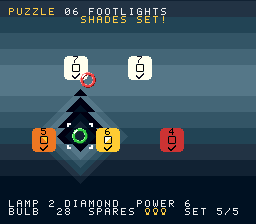
Loading the cartridge (32 KiB)…
Saved states last for this visit. Sound starts with Power.
SHADEWORKS needs a keyboard or a game controller. On a phone or tablet without one you can read about the game here, but you can’t play it yet.
SHADEWORKS
Light-mixing puzzle: steer up to four lamps until every gel cell reaches its target shade; over-lighting wraps back to black.
The stage crew has hung the gels; now someone has to light them. Each puzzle is a small stage of coloured gels, each in a frame painted the shade it should glow. Move the theatre’s lamps, turn them up and down, and make every gel match at once, before the bulbs burn out.
Real cartridge SHADEWORKS is a real 32 KiB cartridge that runs on the emulator, and it plays right here in your browser.
Frames from the cartridge
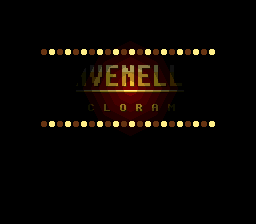
frame 60
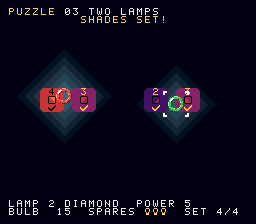
frame 630
frame 1261
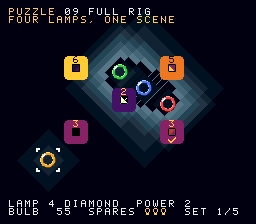
frame 1891
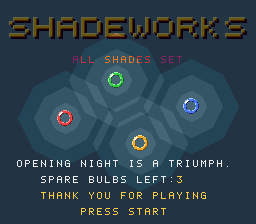
frame 2521
Frames from the project’s golden-frame tests: the emulator plays the cartridge from power-on with a recorded input and must draw exactly these pictures.
1
How a gel gets its shade
Each gel’s frame is painted in its target shade, 0 to 7. The small window in its middle shows the light actually falling on it; when the two match, a check mark appears.
- Ambient light lights the whole stage evenly. Some puzzles have it; you cannot change it.
- Each lamp adds its power at its position, one step less for every step of distance. Its shape decides how distance is counted: diamond, square, octagon, or a band like footlights.
- The shades wrap. Counted 0 to 7, then 8 is 0 again. Too much light turns a gel dark, and later puzzles need exactly that.
2
Controls and bulbs
| Cyclorama pad | In a puzzle |
|---|---|
| D-pad | Move the selected lamp one step |
| A | Lamp power up (0–7) |
| B | Lamp power down |
| C | Select the next lamp |
| START | Pause / resume |
Every change to a lamp uses one unit of bulb life. If the bulb burns out, a spare goes in and the puzzle starts again; three spares last the whole game. Ten puzzles, from First Light to Opening Night.