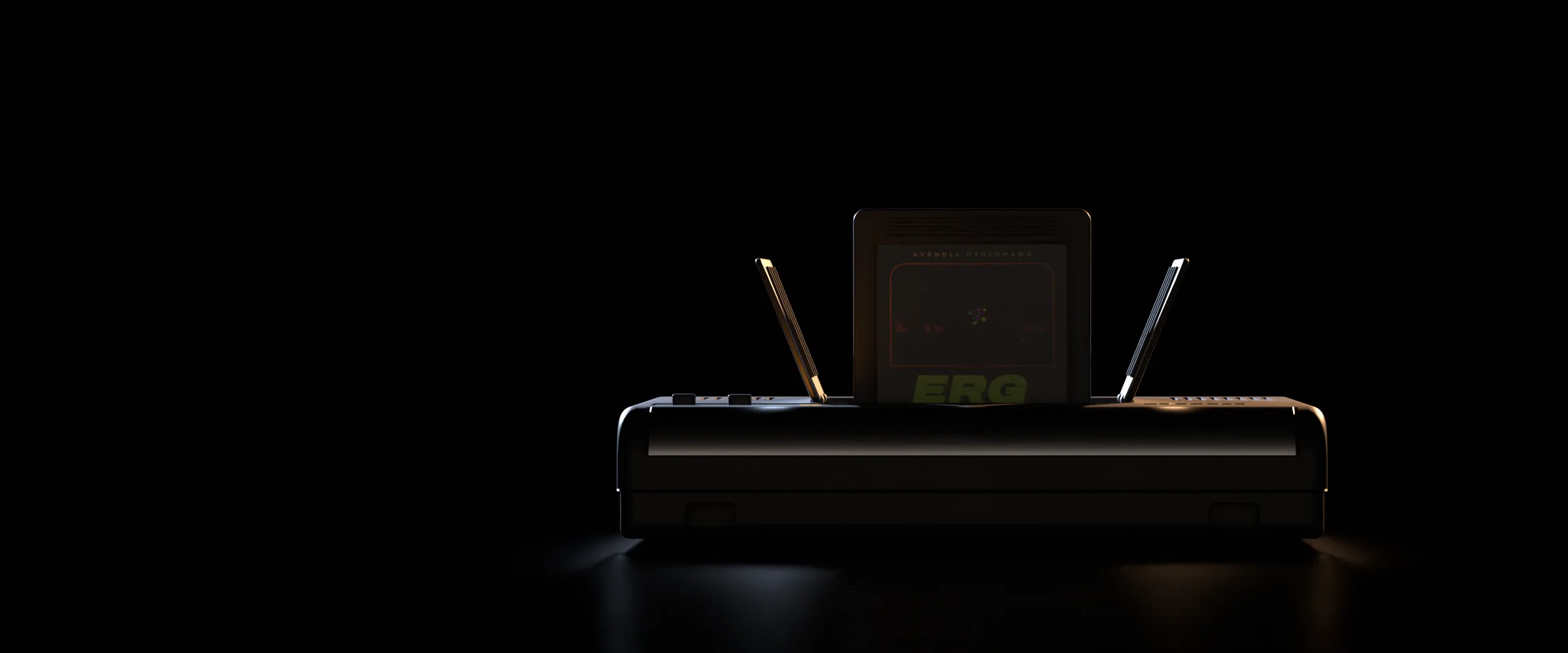
CYC-1001 · Standard cartridge · 128 KiB
ERG: NIGHTSIDE RUN
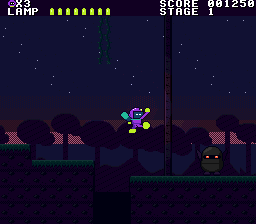
Pack-in title. Erg the astronaut crosses three night-side stages by helmet-lamp light, recharging on glow motes and stomping lamp-eyed Gogglets, to relight the Dawn Beacon.
Avenell and the Cyclorama never existed. The hardware is real: specified, emulated and playable here.
The company, its people, dates, prices and sales are alternate-history fiction. On this site every in-universe statement sits under a red tally lamp. The machine is not invented: its specification, emulator, development tools and cartridges are real software, and every game picture is a frame a real cartridge drew.
This console never existed. Its hardware does: specified to the cycle, emulated in your browser, with real cartridges you can play. Below are its light field, a museum den, its history, its hardware and the documents.
The Barndoor video chip doesn’t only draw a pixel’s colour. Every colour exists in eight shade planes, and for every pixel, in hardware, the chip picks the plane from four positioned lights and an ambient level. It costs the program nothing.
Avenell’s advertising called it Stagelight. Programmers called it the light field. Try it: drag a numbered light, or tab to one and use the arrow keys. This is not an animation of the idea. It is the emulator’s own video renderer, running the chip’s real rule.
level  = sign(I) × max(0, |I| − (d >> F))
shade  = (AMBIENT + level₀ + level₁ + level₂ + level₃) mod 8
colour = CRAM[shade × 64 + palette × 8 + pixel]
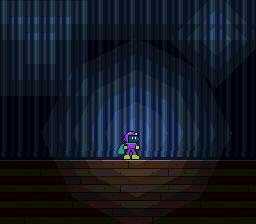
Four lights, ambient 1. Drag a light to move it.
Ramp-filled shade planes; one light follows the player through an ambient dark. Documented in the launch kit.
Shade planes filled with unrelated colours, so light recolours instead of brightening: hidden ink visible only when lit, colour washes, X-ray effects.
Rewriting light registers from the LINE interrupt, so each band of the screen sees different lights: more than four lights, and per-line shapes such as flames, beams and roads drawn with no tile memory.
Deliberately overflowing the 3-bit adder, so overlapping lights wrap into contour rings and faceted interference patterns.
Moving the probe (and lights) mid-frame to use the light field as a coprocessor: hardware distance and visibility queries for game logic.
The hardware never changed. Later games got better only by finding new consequences of the same chip. The three cartridges on this site use the first technique, Lantern.
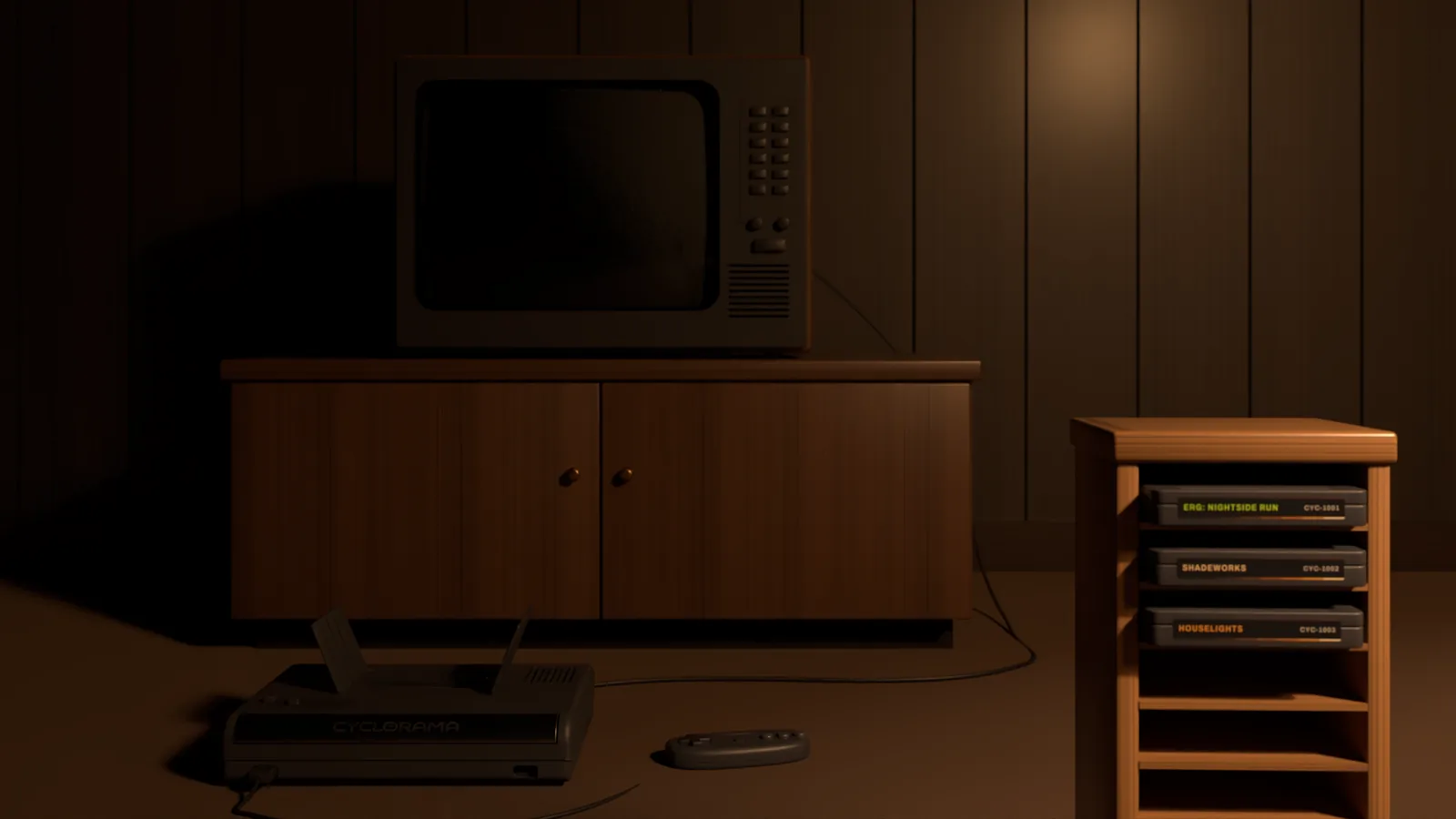
Take a cartridge from the rack beside the television, put it in the CY-1 and switch on. The room is a 3D render with the set switched off; the picture on the tube is a frame the real cartridge drew. The museum page catalogues every cartridge built so far.
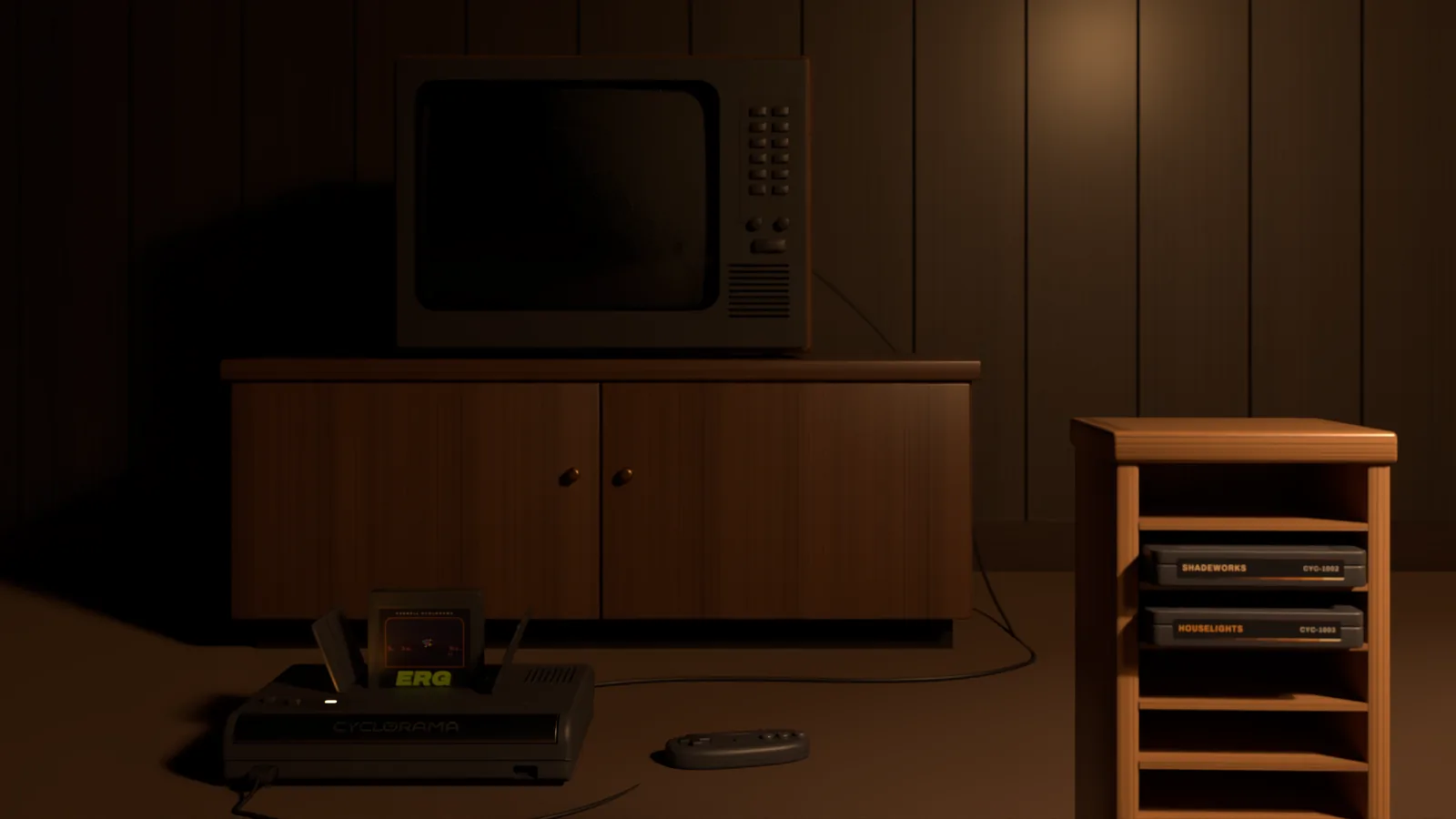
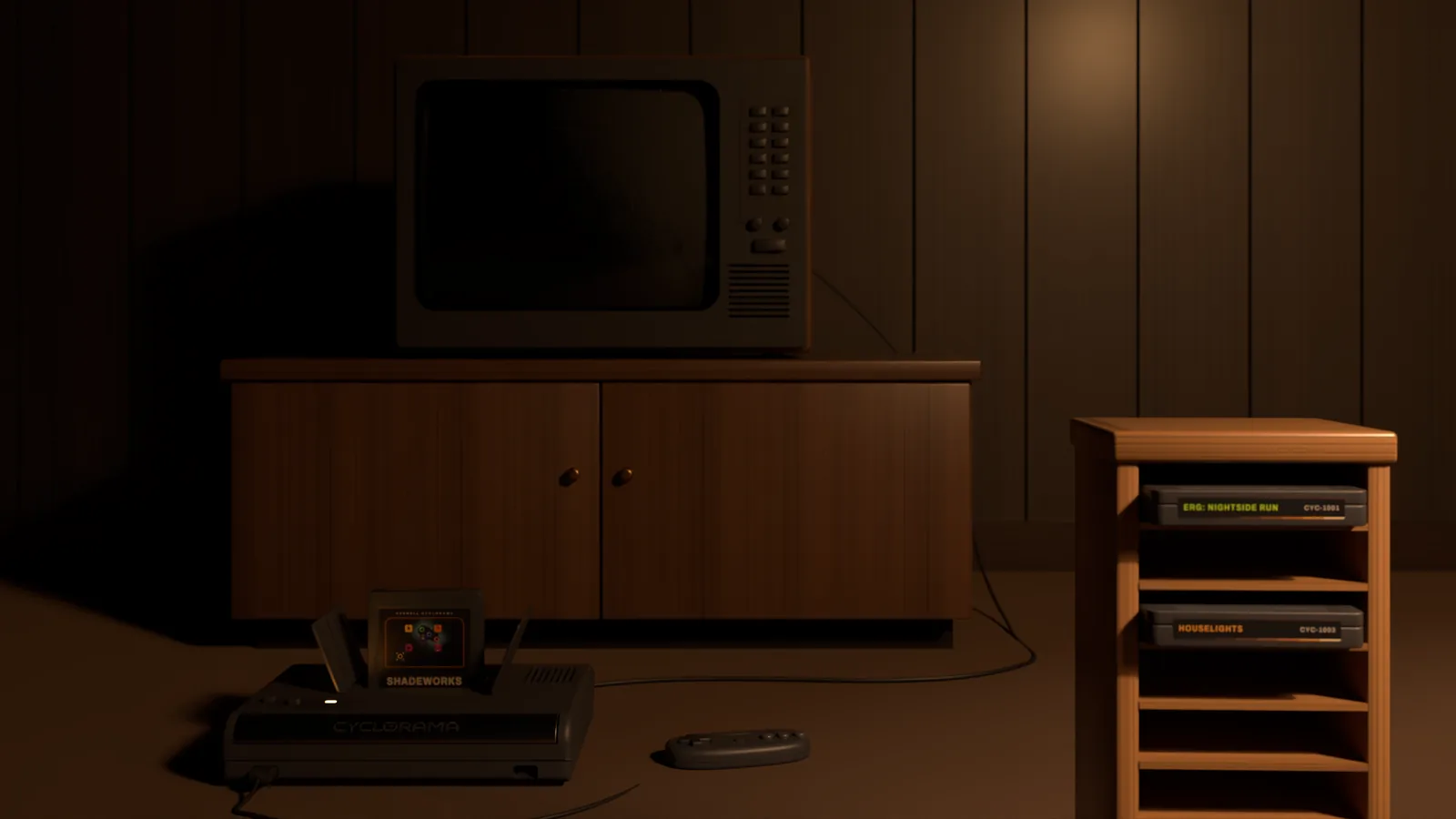
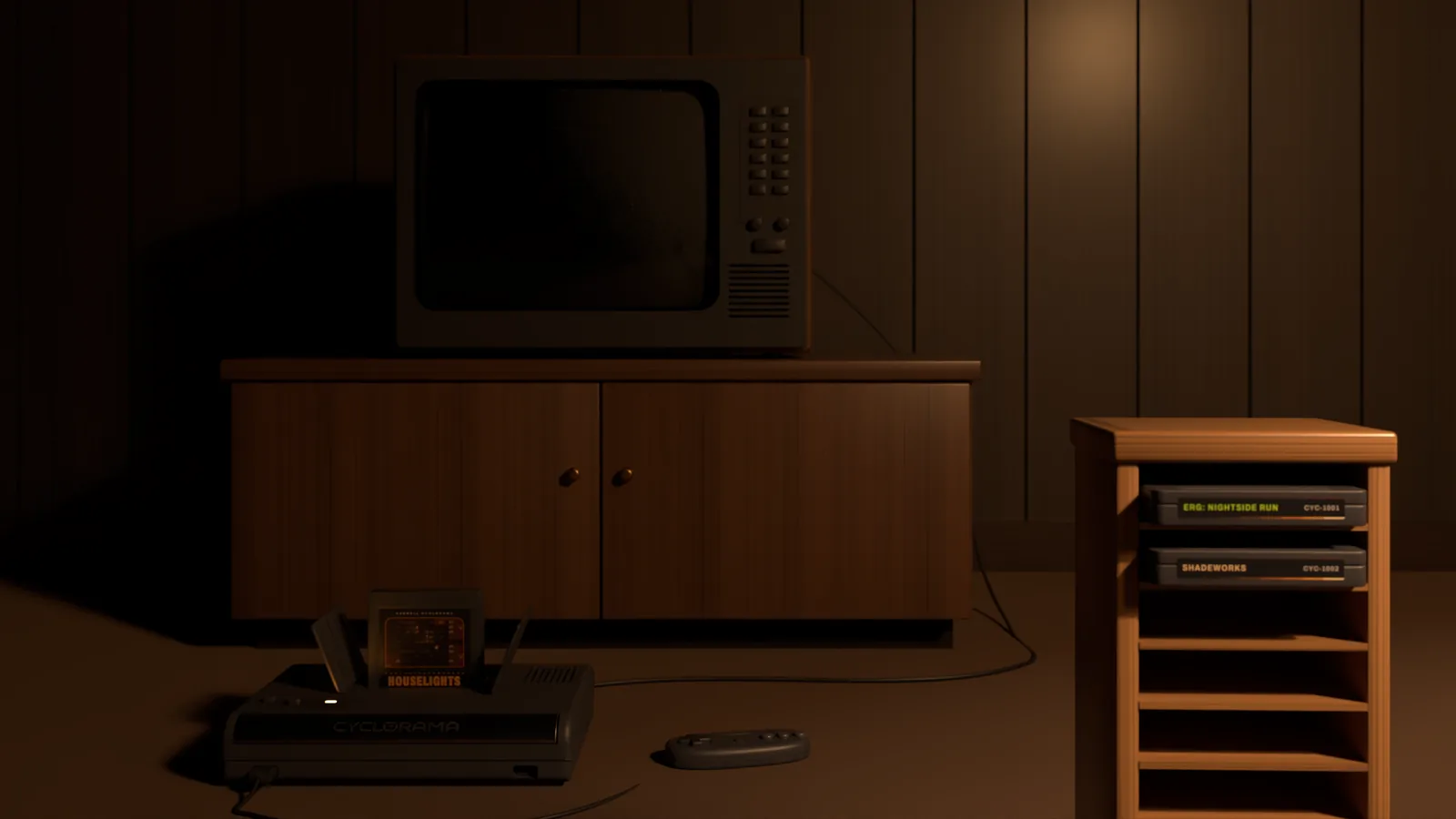

On the rack
Pick one by its end label on the rack; its placard opens here.
CYC-1001 · Standard cartridge · 128 KiB
Pack-in title. Erg the astronaut crosses three night-side stages by helmet-lamp light, recharging on glow motes and stomping lamp-eyed Gogglets, to relight the Dawn Beacon.
CYC-1002 · Standard cartridge · 32 KiB
Light-mixing puzzle: steer up to four lamps until every gel cell reaches its target shade; over-lighting wraps back to black.
CYC-1003 · Standard cartridge · 64 KiB
After the show an usher relights a dark theatre sconce by sconce, in cue order, while the Understudies close in wherever the lantern is not.
In November 1985 Mei-Lin Castellanos wired a spare fade engine, the chip inside Avenell’s Wickline 512 lighting console, to a television instead of a dimmer rack. A soft pool of light followed a joystick around the screen. Everyone who saw it wanted to play in it.
Avenell Stagecraft had built theatre lighting in Toronto since 1974. Harriet Avenell saw a second business; her chief engineer, Samuel Achterberg, saw a chip he already knew how to build. They named the project after the curved, lit backdrop at the back of a stage.
| Q | Date | Event |
|---|---|---|
| 1 | Harriet Avenell founds Avenell Stagecraft Ltd. in Toronto. | |
| 2 | Samuel Achterberg joins as chief engineer. | |
| 3 | The Wickline 512 lighting console ships with Achterberg's fade-engine gate array. | |
| 4 | Mei-Lin Castellanos wires a fade engine to a television raster: the first light-field demonstration. | |
| 5 | The board approves Project Cyclorama and forms the Home Entertainment Division. | |
| 6 | Priya Venkataraman joins to build the development kit; Avenell Playhouse is formed. | |
| 7 | The Cyclorama Development Kit and the SCRIM language ship to the first licensed developers. | |
| 8 | The Avenell Cyclorama is announced to the trade. | |
| 9 | Canadian launch at CA$229.99. | |
| 10 | United States launch at US$179.99. | |
| 11 | United Kingdom launch at £149.99. | |
| 12 | US price cut to US$149.99. | |
| 13 | CY-2 cost-reduced model replaces CY-1; programmer-visible hardware unchanged. | |
| 14 | Deep cartridges (512 KiB to 1 MiB, optional battery RAM) introduced. | |
| 15 | A Barndoor chip yield problem leaves stores short of consoles for the holiday season. | |
| 16 | US price cut to US$99.99. | |
| 17 | Dale Oduya leaves; marketing spend is cut as larger rival systems dominate shelves. | |
| 18 | Colette Marchand's internal memo on the platform's decline circulates among Avenell executives. | |
| 19 | US clearance price of US$69.99. | |
| 20 | Avenell announces the discontinuation of the Cyclorama and closes the Home Entertainment Division. |
2,400,000consoles sold, 1987–1994
After June 30, 1994, Avenell Stagecraft went back to theatre lighting.
The Cyclorama is fiction. Its hardware is not: every number on this sheet is implemented in the emulator you can run on this site, and documented in its programmer’s manual.
| CPU | Tally (AV-1601). Original 16-bit design, 8 general registers, 64 KiB address space, about 3.58 MHz. |
|---|---|
| Video | Barndoor (AV-2210). 256 × 224 pixels, 32 KiB video RAM, 2 tile layers of 8 × 8 tiles, 64 sprites, 16 per line. |
| Colour | 64 base colours × 8 shade planes = 512 entries of 12-bit RGB, from 4096 colours. |
| Light field | 4 lights: position, intensity −8 to 7, falloff 0 to 7, shape diamond, square, octagon or band. A 3-bit adder that wraps. |
| Audio | Cue (AV-3105). 3 tone voices and 1 noise voice, mono, about 47,940 Hz. |
| Memory | 16 KiB work RAM. Cartridge ROM up to 4 MiB in 16 KiB banks; 8 KiB optional battery-backed RAM. |
| Timing | Master clock 945/44 MHz (about 21.477 MHz). 262 lines, 224 visible; about 59.92 frames per second. |
| Input | 2 controller ports. Up, Down, Left, Right, A, B, C and START. |
| Interrupts | VBLANK, LINE, TIMER. |
The machine is documented the way Avenell would have documented it, and the documents are real: you could write a Cyclorama game from them.
We invented a game console that never existed, wrote its hardware specification, built its emulator and development tools, created its software library, and then reconstructed the fictional history around it.
Avenell Stagecraft, its people, dates, prices and sales are alternate-history fiction, marked on this site with a red tally lamp. The machine is not: its specification, the emulator, the development tools and every cartridge here are real software, and every picture of a game screen is a frame a real cartridge drew.
No account and no cookies. Apart from its own files, the site loads one script: Cloudflare Web Analytics, which counts visits and page speed without cookies.